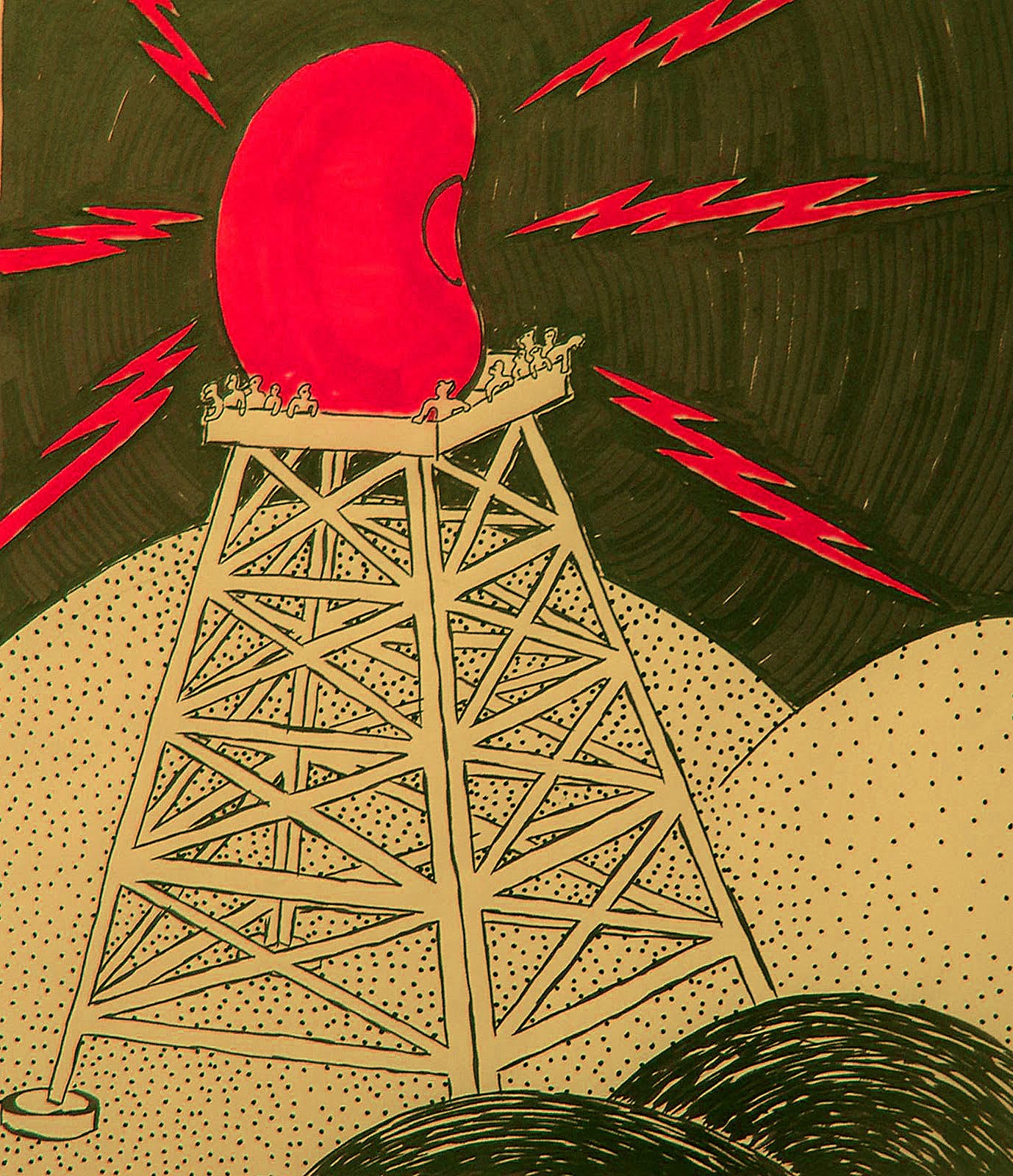
Bean—this is a new drawing I just made. I guess my work is kind of surrealistic, especially my drawings. It depicts a landscape of geometric structures like a high rise with beans in them or maybe it’s producing beans or holding beans. It’s sort of like a pod with beans. The bean has been a favorite image of mine for many years and there are several sculptures of beans throughout my work. The bean is full of promise as a shape. It’s a simple shape, mostly convex, but a little bit of concave. It’s got a shape that’s on its way to do something else. It’s a shape that looks motivated to become two shapes--to bifurcate. It has a middle, a side, a front and a back It’s a shape that represents genesis, the shape of beginning, the shape of the seed, the shape of the very first embryo—we were all beans to begin with. I love the pun, the “human being” and the “human bean.” I’ve made a lot of those images with the bean, full of promise and potential, primordial and simple.
Wednesday, July 13, 2011
Tuesday, July 12, 2011
July 12, Beginning of the Universe
Sometimes, I like to draw things before I build them. I don't always do this, but with this cyclotron, it’s quite a complicated apparatus. A cyclotron is a particle accelerator, used in atomic physics, to accelerate a part of an atom—an electron. The electron accelerates, faster and faster, almost to the speed of light. Trouble is, the faster it goes, the more energy it takes, because as it speeds up it picks up mass. As you approach the speed of light, you can't go any faster, but the more you press down the accelerator, the heavier your car becomes. I use electro magnets to move that electron along on a collision course with another electron coming round the other way. It’s like a game of chicken, but they don’t chicken out. They can’t because the magnetic force won’t allow them to stray. They collide head on at great speeds and with a mass of great ocean ships compressed down to the subatomic size. An extraordinary train wreck of a collision that breaks those electrons up into sub-particles that never before existed, except at the beginning of the universe. It’s a little model of what physicists think of what the BIG BANG was like. It obviously captures the imagination of many physicists, but it has also captured my imagination, so I built my own cyclotron in the studio and I've been experimenting with it. These are some of the first pictures of what I've gotten. See what you think of these new drawings and let me know.
Wednesday, June 15, 2011
Drawing
Drawing is a big part of what I do. I like making things and I like drawing things. Sometimes I make what I draw; sometimes I draw what I make. I have a special idea about drawing. I believe drawing is genesis. If you look around you at any object--furniture, the street, buildings, a computer, clothing, a car, even the entire city--every man made thing you look; every part of our material culture, started with a drawing--that’s why it’s genesis. If you want something, the first thing you do to get it, is to draw a picture of it. Drawing gives the human symbolic power over the object; he takes ownership of the idea of that object. The next step is easy; obtain that object. You think cave men and women made pictures for decoration? Draw the bison, hunt the bison, then eat the bison. Drawing is the realization of desire.
I know this because that’s what happens in my own studio. I took a trip to New Mexico, Arizona, Nevada, and Colorado to look a lot at Anasazi pottery. The Anasazis are the ancient ones, the aboriginal people of southwest America. They like clay and make beautiful pottery with eloquent geometric designs on the pottery. Simple black and white, thin walled, hand built, and decorated with sophisticated geometric patterns. When I got back from my trip I made a big drawing. I had a fireplace that I liked, and I drew that fireplace along with a fabulous collection of Anasazi Pottery on the mantelpiece.
Years later, I met a guy who wanted that drawing but he didn’t have enough money to buy it. He said he had a collection of Native American Art. I traded that drawing for two Anasazi pots which I now prize dearly. If you want it, draw it. It will come to you
It’s interesting that when I teach drawing, lots of people say, “I can’t draw.” For humans, drawing is as basic as walking or speaking. Every human has it hard-wired into them how to draw. We teach it out of children by trying to teach them how to draw what we see. Really, the idea of drawing is not to draw what you see in front of you, but to draw what you see in the profound sense of “what you see.” It’s in your head. You can’t take a photograph of that—the only way out is through the pencil and onto the paper. Drawing is not a fine art, or a work of beauty—it’s a way of communicating. You don’t have to teach a human child how to walk or talk, they do it automatically. At a certain time, they get up and walk, and when they get old enough they start saying words. The same with drawing. We think of drawing as an artform, but it’s not--it’s a language. In walking and talking, no one worries about talent. However, you only get encouragement in drawing if you show talent or a “gift”. Drawing is the realization of desire. Good or bad, everyone needs to do it.
Monday, June 13, 2011
Venus of El Segundo and Venus of Willendorf

Bonnie and Clyde, Adam and Eve, Thelma and Louise. I want to talk about another great couple, The Venus of El Segundo and The Venus of Willendorf. This piece was made in the 80's out of Baltic birch plywood panel with waffle board back so it will never bend or flex. The front surface is gold leafed and then covered with clear lacquer. The image you see is carved into the wood through the gold leaf. When it was finished, I flooded the surface with indigo ink. It sunk into the exposed wood and I was able to wipe the ink off the gold leaf. It’s a nice piece of drawing, very volumetric. Nice to touch. The comparison of images is vivid fat, fullness vs. slim compression. The piece is a diptych--two panels. The Barbie panel is 6 feet tall 2 feet wide. That image was made from a photograph that I took of a 1957 Barbie. I drew it from a photo I made because I wanted it to be very accurate. I used a photograph of the Venus of Willendorf to make my other drawing. The Venus of Willendorf panel has the same number of square inches but it’s a different proportion—it’s about 5 feet tall, 3 feet wide. Barbie is staring at Willendorf but Willendorf can’t return the glare because her wool hat is pulled over her eyes.
I’m telling you about this piece because I think it’s one of the greatest pieces that I’ve made. Just think for a minute of people in the far distant future going to a museum of anthropology and looking at artifacts of the people that lived from 1950 to 2050—a short period of human history. One of the images that keeps reoccurring is this female Venus figure. The clothing wouldn’t survive—just the naked figure of Barbie—and maybe the plastic wouldn’t either—by that time the plastic would have perished—and there would be very few Barbies left. So each Barbie would be a fossil—the plastic, due to certain conditions, wore away. This plastic was dissolved and replaced with a harder material like granite. So that the actual sculpture is not the actual Barbie, but a fossil of Barbie. In any case, we’re thinking about the future. We have no context, only the statue. It’s displayed in a vitrine with a little metal rod holding it up. It’s called the Venus of El Segundo because El Segundo, California, is where Barbies were manufactured. So people would think, “Why is this figure so elongated? Why are the eyes so big? Why doesn’t it have nipples? Why is the body so smooth? Why such small hands? Why such small feet? Why such long legs?” There would be all kinds of explanations to these questions. Scholars would be writing theories, and students would be writing papers about what they think this artifact means. What does it tell us about the people that lived during that era, 1950-2050? Let’s go back 15000-20000 years, somewhere in that range, to a birthday party of a 6 year old girl. Her father didn’t know what to get her for her birthday, there weren’t any stores back then. He was a handy guy and found a piece of stone and carved out an image of the perfect women. It was not an original idea—there were many similar images of the perfect female form. It was special because he carved it for his daughter. He wrapped it up in a basket made out of grasses and presented it to his daughter at her birthday party. When she got it, she loved it. She felt it, held it, played with it, fed it, she even made a little house for her Venus. She and her girlfriends made clothing for it out of materials that were around her. She and the people of that time had no idea that this Venus would ever end up in a museum with people looking at it. It was a doll, it was a toy; it was a teaching toy to tell the little girl what means to be a woman. Just like how our Barbies are teaching tools to tell our daughters what it is to be a woman.
I don’t know if anybody’s thought to make the comparison between Venus of Willendorf and Barbie. It seems silly or funny because it poses something so profound. It tells us that in human evolution, we are so close to the people that made the Venus of Willendorf, that we might have been at the girl’s birthday party. That’s why I think this piece is so great—it gives you a new way of looking at Barbie and the Venus of Willendorf, illustrating the concept of the ideal.
Tuesday, May 17, 2011
Persona
Being an artist, people tend to think of me as a person that happens to make art. But there’s another kind of reality to it—everything I do is art. An artist creates a persona. One of the best examples is Andy Warhol. Everything he did was art and it all fit together—if you asked him a question he never had much of an answer, he was always flat, totally deadpan. Likewise, his work was always flat and literal. He didn't invent imagery as much as he absorbed it. I’m kind of like that too. I’m not like Andy Warhol, but I do have this persona that is not about me as a person. It’s about the artist in my studio. That artist has a belief that he never needs to leave his studio for anything—that everything he needs is in this workspace. I can make my own cell phone, my own brain, my own x-ray images, my own tribal icons, my own chair. I never need to leave to get something because I can make it in house.
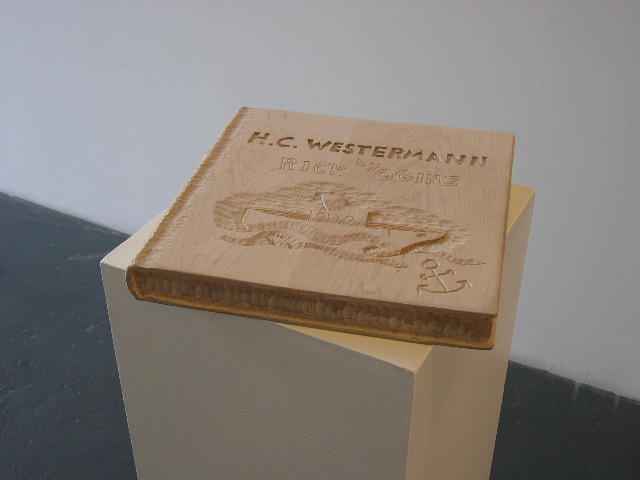
A few examples you might look at; I wrote a book on one of my heroes, H.C. Westerman, and you can see that with my tools, and skills, I’m able to write a scholarly book.
I made “The Heart Lung Machine.” It’s inspired by my interest in medical science, especially organ transplant. One of the most difficult challenges of heart transplant was to invent a machine that can take the place, temporarily, of the heart and lungs. It took years for scientists to perfect that machine. It only took a few weeks for me to make a heart lung machine.
Right now I’m working on a cyclotron, a particle accelerator which speeds up atomic matter to a high velocity, creating high energy. It makes atoms run into each other so they produce a collision that is similar to the big bang. It takes billions of dollars to make one of these things, but I can make it right here in my studio, no problem. Check in later this year, and I’ll have finished my own cyclotron that collides particles, enabling us to see the very creation of the universe.
In the studio I can explore anything—global warming, the earth as viewed from space, human evolution, the destruction of the World Trade Center, and much more. It’s an idea of a persona and workplace where nothing is too small, too big, too complicated, or too theoretical to be put together and taken apart.
Monday, May 16, 2011
Transparency
We usually associate transparency with glass, but I don’t use glass in my sculpture. I use a structure made of various types of wire constructed in a way that not only allows you to see the shape defined by the wire, but also the space contained within the wire. You can also see right through the shape to the background. It creates three different spaces—the shape in space, the space in the shape, and the two of those combined with the surrounding environment.
The simple reason why I’m interested in transparency in sculpture has to do with a metaphor for how we are and how we think of ourselves in the world. Everybody has two ways of thinking of themselves. One way is that this body—arms, legs, feet, hands, hair—is me, Rick. Another way is to think that this body—arms, legs, feet, hands, hair—is Rick’s house; I live in here. We are aware of both senses of the body at different times.
When we’re healthy and well, especially when we are in some kind of physical ecstasy, we think of ourselves as our body. Every little part of our bodies is us. But when we’re unwell, in a transcendent delirious state, or a dream state, we think of ourselves as living inside our body. Think for a minute of the most brilliant man in the world: Steven Hawking. Does he think of himself as his body? Does he think of his body as Steven Hawking? I doubt it. He probably thinks of himself as a prisoner trapped in his body.
We all have that feeling sometimes. That’s where my idea of transparency comes about—it presents the body and reveals space within that can be occupied or emptied, in the sense that you can see right through it depending on its internal state. In one of my latest sculptures, “Infection,” I constructed beautiful corpuscles out of red wire that are invading a wooden structure. The wooden structure is geometric, the corpuscles are organic. Solid=rational, transparent=chaos.
This is a sculpture of a big head, a self-portrait made of copper wire. It stands on a wood structure that is just my shoulder height, with an opening for my head. Not so much a self-portrait, but a head trap just for me.
In the wire sculpture called “Hands,” you’re invited to put your hand inside the hand, but you’re still outside the chamber that contains the hand itself.
You also see this use of transparency in drawing a full figure with an opening for the top and another for the bottom.
In an older sculpture called Medicine Chest, a characteristic of transparency indicates that the form is in the process of construction.
Friday, May 13, 2011
THE FEMALE PELVIS--DON'T FORGET ABOUT IT
I’ve always been interested in human development—how we’ve changed so much in our evolutionary history. What differentiates us from other animals. What makes us unique? I always read about the opposable thumb, walking upright, and the use of tools as the things that make us different. The one thing that’s central to human evolution is the bigger brain. If you compare the skull of another primate to the human skull, the shape is very different because of the growth, called the cortex, at the top of the brain. The cortex has grown immensely, like a melon.
What good is it to have a really big brain? It means you have a big head. What good is a big brain and a big head if you can’t be born? The birth canal, the pelvis, is what really makes the big brain possible. Its ability to flex and give birth to such a big brain is the most important development in human evolution. If it can’t fit through that tunnel, forget about it. Everything about our evolution comes down to the architecture, size, and flexibility of the female pelvis—that is the key to human development.
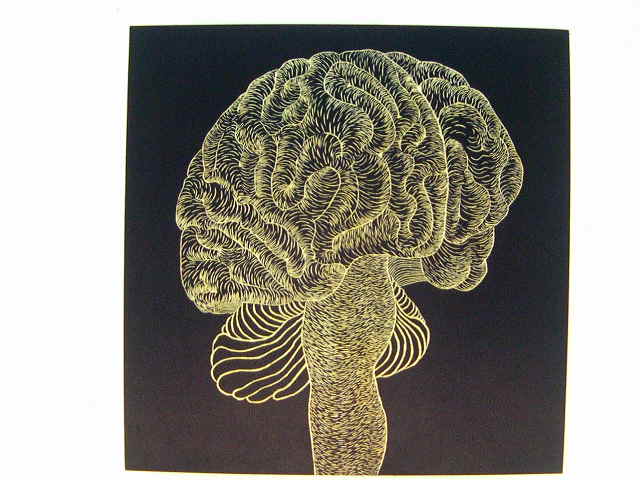
Having this idea in mind, I started looking at the skeleton of the female pelvis. I’ve always loved a female pelvis, but I fell in love with the skeleton of it, and it’s become my landscape for the past few months. I’ve been making lots of images of it. It looks funny like a crazy pair of sunglasses, or a hat worn at a royal wedding. I see the fascination Georgia O’Keefe had with the skulls—the bone whiteness of it. I’ve been juxtaposing those images with my other favorite landscape—the brain, with all the folds. These two landscapes together tell the story of human evolution in a way that’s meaningful to me. They are landscapes that are visually evolving, and can be explored in different ways with different materials—in drawing and in sculpture. I’ve been thinking about an animated sculpture, depicting the birth of the brain—coming out of the pelvis and going back in.
The female pelvis has to do many different things—pass the big brain through, stand up vertically, and allow vertical propulsion. You have to be able to run and jump, so it can’t be too wide—otherwise, you can’t run. If it’s too small—if a female is much smaller than the male—that’s not going to work either. In some species it works, but not with us, not with our big brains. That’s why, in human evolution, the size and weight of men and women has been getting closer and closer. By now, in our evolutionary history, there’s not much difference between male and female, as compared to whales, for example—the male being three times bigger than the female. Take a look at the female pelvis and its role in human evolution—I think it’s been overlooked. Tell me what you think.
Subscribe to:
Posts (Atom)